
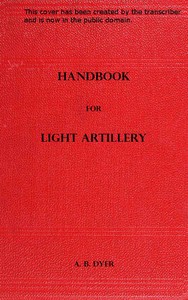
Handbook for Light Artillery by A. B. Dyer
Okay, let's be clear from the start: this is not a novel. There's no sweeping plot or cast of characters. 'Handbook for Light Artillery' is exactly what it says on the cover: a technical manual. Written in the late 19th century by Colonel Alexander Brydie Dyer, it was designed to be the go-to resource for artillery officers. The 'story' it tells is the step-by-step process of mastering light artillery.
The Story
The book walks you through everything. And I mean everything. It starts with the anatomy of the gun itself—naming every part of the cannon, carriage, and limber. Then it gets into the real work: how to hitch the horses, how to march the battery over different types of terrain, and how to set up for firing. Dyer lays out the drills with precision: the commands, the movements of each soldier in the crew, the loading procedure, and finally, the mathematics of aiming. He doesn't just tell you to point and shoot; he explains the geometry of hitting a target a thousand yards away. The final sections cover maintenance, repairs in the field, and even the care of the horses. The narrative is one of relentless, organized preparation for controlled chaos.
Why You Should Read It
This book fascinated me because of its sheer specificity. It strips away the romance of battle and shows you the craft. You gain a huge appreciation for the skill involved. These weren't just soldiers; they were mechanics, mathematicians, and teamsters. Reading the exact drill commands makes you feel the pressure and coordination needed to fire three rounds a minute while under attack. Dyer's voice is direct, authoritative, and occasionally reveals dry humor about the frustrations of army life. You're not reading about history; you're holding a primary piece of it, seeing exactly what knowledge was considered essential for survival and success on a 19th-century battlefield.
Final Verdict
This book is a niche treasure. It's perfect for hardcore military history enthusiasts, historical reenactors, or writers doing deep research for a period novel or film. If you love understanding how things *actually* worked, you'll be glued to the pages. For the casual reader looking for a narrative history, it will feel like reading a textbook. But if you want to truly get inside the mind of a Civil War or frontier-era artilleryman, to understand his daily reality beyond the smoke and noise, there is no better guide than Colonel Dyer's handbook. It's a masterclass in a forgotten profession.
You are viewing a work that belongs to the global public domain. Enjoy reading and sharing without restrictions.
Jessica White
10 months agoFrom a researcher's perspective, the way it challenges the status quo is both daring and well-supported. It’s a comprehensive resource that doesn't feel bloated.
Karen Martinez
2 months agoGiven the current trends in this field, the footnotes provide extra depth for those who want to dig deeper. Thanks for making such a high-quality version available.
Emily Thomas
1 year agoFrom a researcher's perspective, the bibliography and references suggest a high level of research and authority. It definitely lives up to the reputation of the publisher.
James Martin
10 months agoUnlike many other resources I've purchased before, the formatting on mobile devices is surprisingly crisp and clear. A trustworthy resource that I'll keep in my digital library.







Donald Gonzalez
9 months agoAs a professional in this niche, the argument presented in the middle section is particularly compelling. Truly a masterpiece of digital educational material.