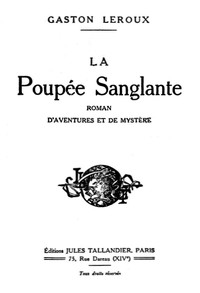
La Poupée Sanglante by Gaston Leroux
Gaston Leroux, the mind behind The Phantom of the Opera, had a real taste for the strange, and La Poupée Sanglante (The Bloody Doll) might be his strangest creation. It’s a book that defies easy labels, blending mystery, horror, and tragedy into something unforgettable.
The Story
The story follows Gabriel, a gifted but troubled scientist. His great work is a stunningly lifelike automaton, a doll crafted in the image of his friend’s wife, the beautiful Héloïse. Gabriel is secretly in love with her. When Gabriel is found brutally murdered in his locked laboratory, the mystery seems impossible. The only other thing in the room? The flawless doll. But this is no ordinary whodunit. Gabriel’s spirit doesn’t pass on—it becomes fused with the mechanical doll. Now ‘alive’ with a man’s memories and passions, the Bloody Doll begins to move, to speak, and to yearn for Héloïse. The plot twists as the doll becomes both a vessel for a ghost and a key suspect in its own creator’s death, leading to a climax that is as heartbreaking as it is shocking.
Why You Should Read It
What grabbed me wasn’t just the spooky premise, but the deep sadness at its core. This isn’t a story about a monster; it’s about a trapped soul. The doll is a tragic figure. It feels a man’s love and jealousy but is forever separated from humanity by its wooden body. Leroux makes you feel for this creature in a way that’s surprising. The book also asks big questions about what makes a person real. Is it the body, or the mind and memories inside it? The atmosphere is pure Gothic Paris—shadowy streets, grand mansions, and a constant sense of dread—but the central idea feels weirdly modern, almost like an early take on AI or consciousness transfer.
Final Verdict
This book is perfect for readers who find classic horror a bit tame and want something with more philosophical bite. If you enjoyed the tragic romance of Phantom but wished it had more murder-mystery and sci-fi elements, you’ll love this. It’s also a great pick for fans of vintage weird fiction—think of it as a French cousin to the stories of Edgar Allan Poe or early sci-fi pioneers. Fair warning: it’s bizarre, melodramatic in the best way, and utterly unique. You won’t read anything else like it.
This text is dedicated to the public domain. Access is open to everyone around the world.